Pool care
A Bali pool lives under equatorial UV, daily swimmers and four months of rain. This is the whole chemistry routine in one page: what to dose daily, what to check weekly, and what to do when a storm turns the water green.
5 min read · 2026-09-20
Pool water does not fail suddenly; it fails over three unwatched days. The chemistry itself is simple - two numbers and a routine - but the tropics punish skipped days harder than any temperate market. Equatorial UV destroys free chlorine at double the rate owners from Europe or Australia expect, which is why the dosing habits they bring with them quietly fail here.
Free chlorine should hold at 1-3 ppm, and pH at 7.2-7.6. Chlorine sanitises; pH decides whether the chlorine actually works and whether eyes sting. Above pH 7.8, chlorine loses most of its killing power and you start overdosing to compensate. Everything else - alkalinity, stabiliser - is worth checking monthly, but these two run the pool.
A typical 40 cubic-metre villa pool uses 4-8 kg of granular chlorine per month, and more in storm weeks when rain dilutes the water and washes in organics. That is why we tell clients to plan stock quarterly: one 25 kg pail is a comfortable quarterly buffer for a single villa pool. Per our price list, a 50 kg pail runs IDR 1.4-2.1 juta - cheap insurance against buying retail sachets at triple price in the middle of high season. Most of our villa clients put pool chemicals on a scheduled monthly route and stop thinking about the category.
Storage matters as much as stock. Keep chlorine in its sealed pail, off the floor, in a ventilated room away from housekeeping chemicals - chlorine and acids must never share a shelf. A dry storeroom keeps granular chlorine potent for a year or more; a humid one turns it into expensive clumps. For new properties, the pool starter kit sits alongside everything else in the package builder, so the water is balanced before the photographer arrives, not after.
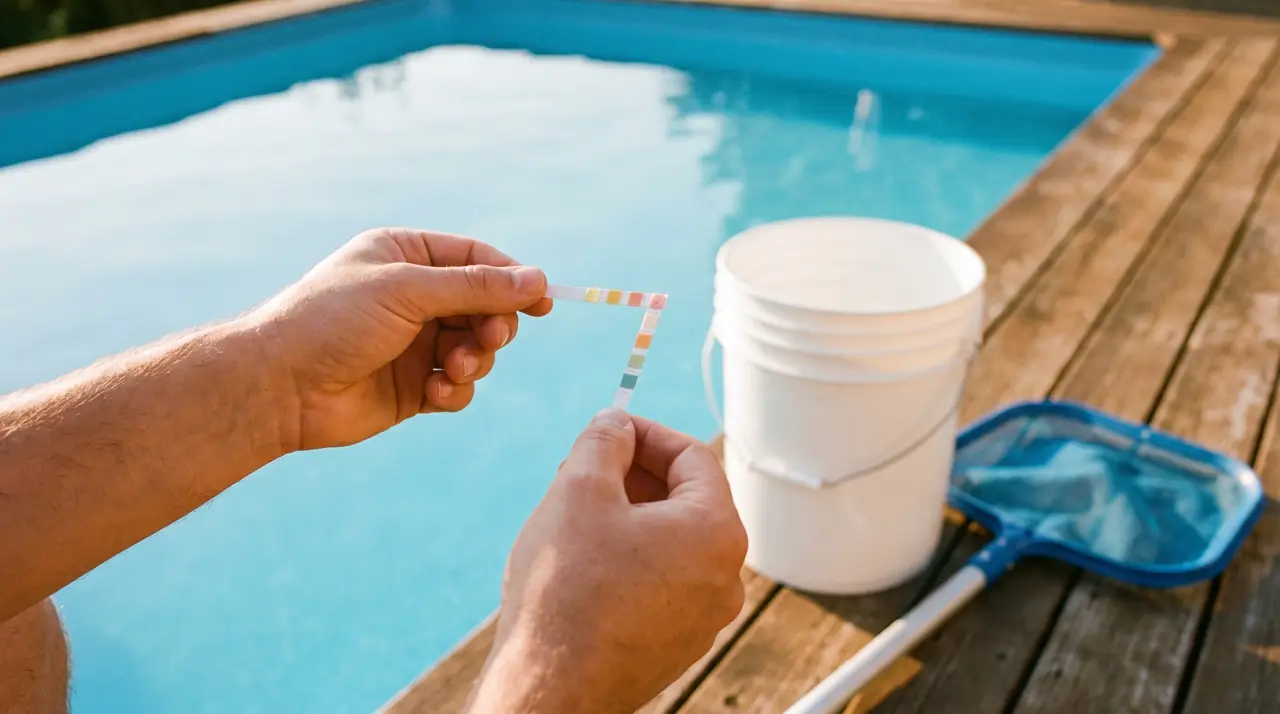
Test strips are fine for the daily staff routine: fast, idiot-proof, accurate enough to catch drift. A digital tester earns its price on properties with multiple pools or a manager who wants numbers in a logbook rather than colours held up to the sky. Our starter kits ship with both and a laminated dosing card calculated for your exact pool volume - three lines your staff can follow without a chemistry degree. Managers running several villas standardise the card across properties so any staff member can cover any pool.
Shock the pool after any storm, any party, any green tint, and routinely once a week in the evening. If you can smell chlorine strongly, the pool usually needs more, not less - that smell is spent chlorine asking for backup.
Test and correct pH first, shock with granular chlorine in the evening, dose algaecide, run the pump 24 hours, then floc and vacuum the fallout. Two days, not a drained pool.
Both: granular for daily control and shocks, tablets in a floater as a baseline and for staff days off. The dosing card covers the split.
Yes - a heavy wet-season downpour dilutes chlorine and drops pH within hours. The after-storm routine exists precisely because Bali gets forty of those per season.
Keep reading

Everything a new villa needs before the first guest: room-by-room quantities, budget tiers and the order-by dates that save the launch.
View →
Small plastic water bottles are banned, minis are on the way out. What the rules say, what inspectors check, and the refill migration plan that pays for itself.
View →
Why home mattresses fail in the tropics, how to pick firmness for international guests, and the protector rule that saves the investment.
View →Questions?
Tell us about the property - we reply with a stock list, unit prices and delivery dates.